
ICT-207 Active Long + Short Version 1.0

ICT Judas Swing

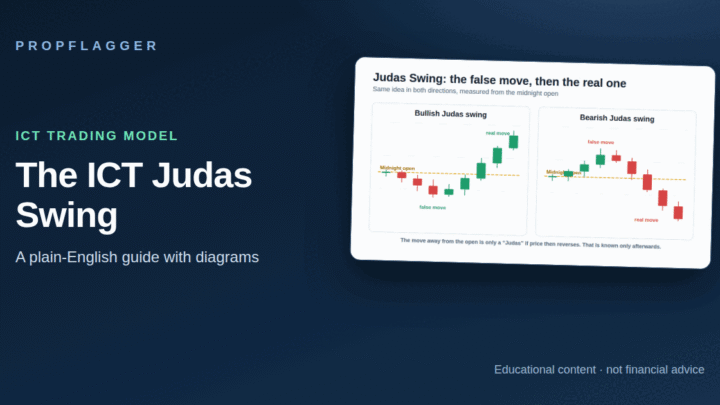
Price pushes above the open and takes a marked high, then displaces back below the open and shifts structure down. The entry is planned on a retracement into a gap or order block, with the stop above the false-move high.

This page documents my own methodology for educational purposes. It is not a recommendation, and following every criterion does not make a trade more likely to succeed.

Strategy overview

The Judas Swing is a convincing move one way at the start of a session that then reverses and goes the other way. The usual reference is the New York midnight open, drawn as a horizontal line, and the swing is typically described between midnight and about 5:00 AM New York time, frequently around the London open at 3:00 AM.

Several “opens” can be used (midnight, London, New York 9:30), so the anchor is a parameter to fix in advance. Choosing it after the fact is overfitting, which is why the checklist records it.

This page documents the criteria I check, for education only. It is not a recommendation to trade, and following every criterion does not make a trade more likely to work. Every journal entry that uses this module records the checklist honestly, including trades that failed.
Read the full guide: ICT Judas Swing Explained: The False Move at the Session Open →

Strategy record

No public journal entries use this strategy yet. This record fills in by itself as entries are published; nothing is estimated.

Long logic

Price pushes below the open and takes a marked low, then displaces back above the open and shifts structure up. The entry is planned on a retracement into a gap or order block, with the stop below the false-move low.

Short logic

Price pushes above the open and takes a marked high, then displaces back below the open and shifts structure down. The entry is planned on a retracement into a gap or order block, with the stop above the false-move high.

Criteria (version 1.0)

Each criterion has equal weight in Strategy Match. Strategy Match = criteria met ÷ total criteria × 100.

Historical journal statistics

No recorded trades to show yet. Nothing is estimated or filled in.

Related journal entries

No public journal entries for this strategy yet.

Author commentary

Every criterion carries equal weight in Strategy Match. That is a simplification: it counts how many documented conditions were present, it does not say which matter most, and it says nothing about the probability of success. Several of these conditions (“obvious” liquidity, “strong” displacement) are judgements that two people can mark differently, so mark them before the move, not after.

Version history

Journal trades stay linked to the version they were logged with, so older entries keep their original criteria.

  • 1.0 — 2026-10-14 — Initial version.